Your sales force should play a key role in innovation-focused interviews. But not by themselves. Unaccompanied sales reps seldom attract all the right customer contacts, and they’re not rewarded for the lengthy time horizons required. Besides, market-facing innovation requires central coordination, since a single sales territory won’t contain all the needed prospects. However, your sales force can play a critical role when it also becomes a learning force.
More in 2-minute video at 47. Make your sales force a learning force
If the customer felt they helped you with your interview, you probably wasted your airfare. But if they felt it was their interview, asked for a copy of the notes, and said you were a good meeting facilitator… you probably learned things your competitors don’t know. B2B insight skills are needed for this. Do your people have them?
More in e-book, www.reinventingvocforb2b.com (page 9)
Want to add employees who know your technologies and markets, can start work tomorrow, and cost nothing more? It’s easy: Just kill the dead-end projects that tie up half your resources. Free your people to work on projects your customers actually care about. It’s not hard to learn which projects to kill. In fact, strong project teams will halt weak projects on their own. Many will do this using the data-driven evidence that comes from market satisfaction gaps.
More in white paper, www.marketsatisfactiongaps.com
If you see a business that has steadily grown over the years in size, profitability and stature… whose products have surpassed competitors’… that grinds through the hard work of delivering real customer value… that brushes aside fads, downturns and criticisms… look for the builder. If this is you, we can show you some power-tools for your next project.
More in 2-minute video at 3. Be a business builder
If your new product development process starts with your ideas—instead of B2B customers’ desired outcomes—your new product may be an answer to the wrong question(s). You’ll likely a) miss important customer outcomes, or b) misinterpret the importance of the customer outcomes you have identified.
More in white paper, www.guessingatcustomerneeds.com
If all customer outcomes in a market are either unimportant or already satisfied, you’ll see low Market Satisfaction Gaps. This is an over-served market, and there’s only one thing that makes these customers happy: Dropping your price. Race to more attractive markets and hope your competitors waste resources here. Have you identified your over-served markets yet?
More in white paper, www.marketsatisfactiongaps.com
Where else do you invest tens of millions of dollars in personnel, so that many can work diligently on answers to the wrong questions? If your firm is like most, one-half of your product development resources are working on projects that will be cancelled or fail to yield an adequate return. You can stop this innovation malpractice with the science of B2B customer insight. Specifically, you must stop projects from entering the development stage unless you have data-driven evidence of customer needs.
More in 2-minute video at 35. Insist on data-driven innovation
In concentrated B2B markets, the top ten buying accounts may represent 50-100% of the buying potential. Unlike B2C—with deep pools of potential prototype testers—B2B suppliers can wear out their welcome by lobbing sloppy “minimum viable products.” If you use Lean Startup, be sure to begin with proper B2B customer interviews.
More in white paper, www.leanstartupforb2b.com (page 7)
Years from now, we’ll think it quite strange that B2B companies explored market needs by launching products to see if anyone would buy them. In the future, B2B companies will have a complete understanding of market needs before they begin developing their products, let alone launch them. Want to start before your competitors?
More in white paper, www.b2btimingiseverything.com (page 5)
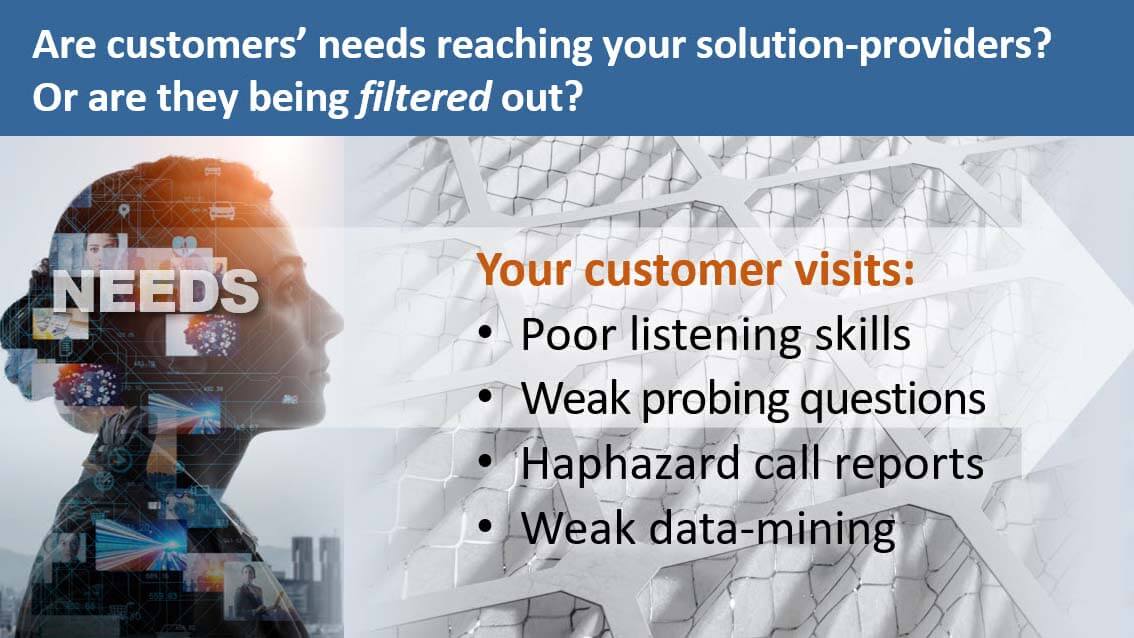
Every one of your B2B customers has needs… problems to be solved. What’s filtering them out, preventing your solution providers from understanding them? 1) Poor listening skills when your employees meet with them? 2) Few probing questions? 3) Haphazard call reports? 4) Weak CRM datamining? You can change all this when your customer-facing employees use Everyday VOC.
More in Everyday VOC white paper, www.EVOCpaper.com
Clever companies realize they’ll “hear what they want to hear” without quantitative VOC. To do it right, B2B companies should weight responses based on customer buying power. And don’t just ask for importance ratings: Ask for satisfaction ratings as well. The only hope for premium pricing is pursuing needs that are both important and unsatisfied. You can use something called Market Satisfaction Gaps to point you in the right direction.
More in white paper, www.marketsatisfactiongaps.com
If a stock’s P/E ratio is 20-to-1, then only 5 percent of a firm’s value is driven by this year’s earnings. Put another way, 95 percent of shareholder value is driven by investors’ expectations of the future. Executives with rich stock options have “motive and opportunity” to manipulate these expectations… in ways that often damage the firm’s long-term health.
More in 2-minute video, 5. Shareholder wealth is a poor goal
Think your VOC work is done if you can splash some pithy customer quotes on a PowerPoint slide? Nope. You must conduct quantitative interviews to isolate the important, unsatisfied outcomes (using 1-10 scales). We all “hear what we want to hear”… so unfiltered customer data is needed. Never spend development dollars until someone “shows you the numbers.” The most important numbers are something called Market Satisfaction Gaps.
More white paper, www.marketsatisfactiongaps.com
If your new product development process begins with “idea generation,” is it your idea… or your customers’? If you start with your idea, you probably won’t understand customer needs until the end… by seeing if they buy your new product. Why not flip your approach and start with customer needs? Unless you’d rather your R&D kept guessing at customer needs.
More in white paper, www.guessingatcustomerneeds.com