Consider this logic chain for growth: A) Your only path to profitable, sustainable growth in in creating customer value. B) The only way to create customer value is by improving important, unmet customer outcomes. C) Most companies do a poor job today of identifying which customer outcomes to improve. D) Proven methods are now available to confidently target a market’s important, unmet outcomes. ... Read More
“The Voice of the Customer”, an article by Abbie Griffin and John Hauser from 1993, joined the parallel worlds of academic market research with the practical discipline of new product development. As such, “The Voice of the Customer” built upon the leading framework at the time for building new products, QFD. (“QFD”, or “Quality Function ... Read More
Most B2B companies waste millions of dollars in failed product development. This often isn’t because their scientists can’t come up with good answers… but rather they’re working on the wrong questions. Good customer insight lets you move into the Non-Obvious zone, working on customer problems your competitors miss. ... Read More
More than anything else, short time horizons restrain B2B organic growth. And this leads to “internal friction” in your growth machine, specifically in 4 areas: 1) available time, 2) required skills, 3) team motivation, and 4) organizational disruptions. ... Read More
If you sell into a concentrated B2B market (one with just a few customers), your voice-of-customer interviews should have two goals: “insight” plus “engagement.” The latter is important: You want these big customers to be impressed and eager to work with you, not your competitors.
These 10 approaches help you engage your customers when interviewing them to understand their needs: 1) Kill the questionnaire. 2) Let customers lead the interview. 3) Discuss their job-to-be-done. 4) Project your notes so they can see them. 5) Focus on customer outcomes. 6) Learn how to probe deeply. 7) Don’t sell or solve. 8) Get quantitative in your VOC. 9) Use triggers to generate fresh ideas. 10) Use B2B-optimized interview tools. (See the 2-minute video, Engage your B2B customers.)
These are explained in the article, The Missing Objective in Voice of Customer Interviews
Portfolio management links strategy with execution for new product development. A Voice of the Customer program maximizes ROI for all new product initiatives, whether incremental or breakthrough. ... Read More
To move from supplier- to customer-centric innovation, B2B producers should shift their thinking in four areas: 1) new markets to new supplier, 2) validating hypotheses to uncovering outcomes, 3) competitive products to customer alternatives, and 4) competitive pricing to value creation. ... Read More
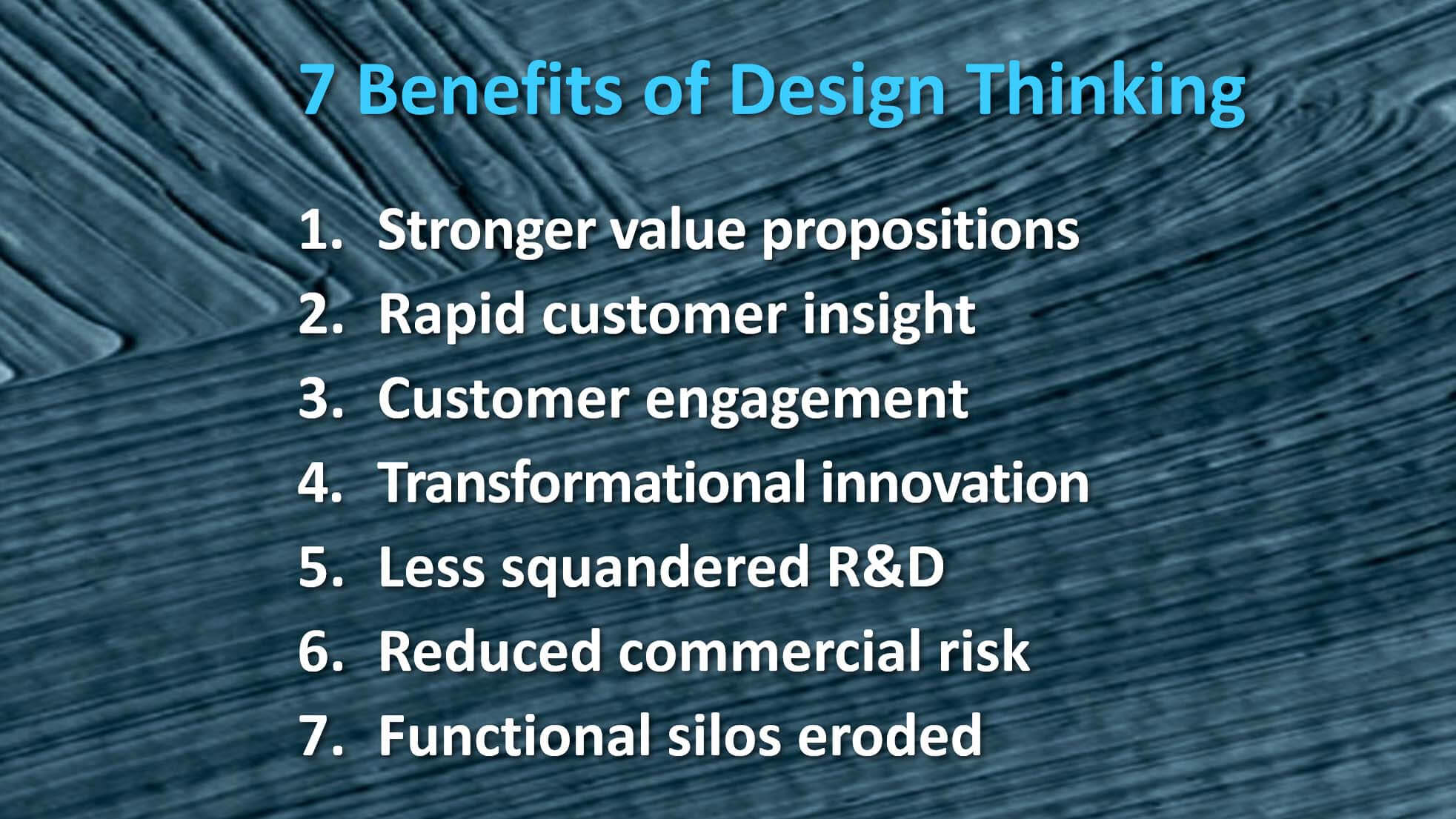
If you haven’t explored Design Thinking for your product development yet, I highly recommend you do. It brings seven important benefits: 1) stronger value propositions, 2) rapid customer insight, 3) improved customer engagement, 4) potential for transformational innovation, 5) less squandered R&D, 6) reduced commercial risk, and 7) the erosion of functional silos.
But if you’re a B2B company, don’t simply use Design Thinking as it’s taught in design schools. You can optimize it for B2B, especially the first two steps, “empathize” and “design”… using B2B-optimized Discovery and Preference interviews.
More in white paper, Design Thinking Optimized for B2B
With New Product Blueprinting, you use creative foresight and a detailed plan for new product development… similar to an architect’s planning before breaking ground. The process includes 7 steps: 1) market research, 2) Discovery interviews, 3) Preference interviews, 4) side-by-side testing, 5) product objectives, 6) technical brainstorming, and 7) business case. ... Read More
Portfolio management links strategy with execution for new product development. A Voice of the Customer program maximizes ROI for all new product initiatives, whether incremental or breakthrough. ... Read More