In concentrated B2B markets, the top ten buying accounts may represent 50-100% of the buying potential. Unlike B2C—with deep pools of potential prototype testers—B2B suppliers can wear out their welcome by lobbing sloppy “minimum viable products.” If you use Lean Startup, be sure to begin with proper B2B customer interviews.
More in white paper, www.leanstartupforb2b.com (page 7)
Tired of new product failures? Get one simple step right and your new product success rates will soar. For B2B companies, this step is prioritizing customers’ needs. Not sure about that? We’ll show you strong evidence that supports this… and show you how to turn new product failures into rare and distant memories. What’s more ... Read More
Years from now, we’ll think it quite strange that B2B companies explored market needs by launching products to see if anyone would buy them. In the future, B2B companies will have a complete understanding of market needs before they begin developing their products, let alone launch them. Want to start before your competitors?
More in white paper, www.b2btimingiseverything.com (page 5)
Finance is the calculus of growth. Engineers, product managers, and CEOs are all guided by financial metrics to lead the business to fulfill its purpose: sustainable, profitable growth. Meanwhile, the outside world uses finance to estimate firm value and potential. Perhaps due to the breadth of stakeholders, it’s easy for a company to slip into ... Read More
It’s natural to ruminate on the future; in particular, about technology adoption. What changes will future technology waves bring? Will we ride them to riches or drown under the weight of disruption? A Danish proverb warns that “Prediction is dangerous, especially about the future.” A cycle of bad logic Unfortunately, when we theorize, we can ... Read More
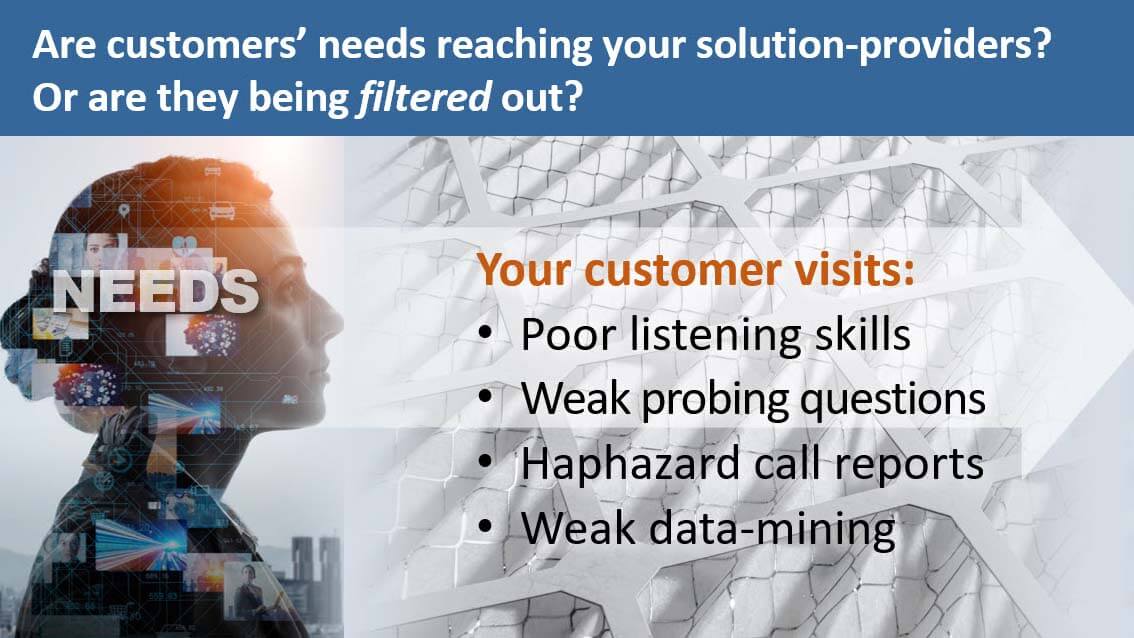
Every one of your B2B customers has needs… problems to be solved. What’s filtering them out, preventing your solution providers from understanding them? 1) Poor listening skills when your employees meet with them? 2) Few probing questions? 3) Haphazard call reports? 4) Weak CRM datamining? You can change all this when your customer-facing employees use Everyday VOC.
More in Everyday VOC white paper, www.EVOCpaper.com
Your “second objective” after customer insight should be customer engagement. These 9 approaches help: 1) Kill the questionnaire, 2) let customers lead, 3) discuss their “job-to-be-done,” 4) project your notes, 5) focus on customer outcomes, 6) probe… deeply, 7) don’t sell or solve, 8) get quantitative, and 9) use triggers. ... Read More
What is Smarketing? “Smarketing” is when marketing is only executed with a short-term, sales mentality. It’s the unholy melding of sales and marketing. Why is this bad? With Smarketing, the longer-term, less urgent, strategic marketing activities are pushed aside. It’s what remains when strategic marketing is absent. Strategy begins with segmentation. Click here to read ... Read More
For new product success, it’s critical to continuously understand customer needs. There’s only one true path to do this well: Your company must develop the competency to interview customers, to gather and prioritize needs. But additionally, are there times when the best decision is outsourcing VOC projects? Yes, there will be. But first, let’s review ... Read More
Clever companies realize they’ll “hear what they want to hear” without quantitative VOC. To do it right, B2B companies should weight responses based on customer buying power. And don’t just ask for importance ratings: Ask for satisfaction ratings as well. The only hope for premium pricing is pursuing needs that are both important and unsatisfied. You can use something called Market Satisfaction Gaps to point you in the right direction.
More in white paper, www.marketsatisfactiongaps.com