It’s natural to ruminate on the future; in particular, about technology adoption. What changes will future technology waves bring? Will we ride them to riches or drown under the weight of disruption? A Danish proverb warns that “Prediction is dangerous, especially about the future.” A cycle of bad logic Unfortunately, when we theorize, we can ... Read More
If your new product development process begins with “idea generation,” is it your idea… or your customers’? If you start with your idea, you probably won’t understand customer needs until the end… by seeing if they buy your new product. Why not flip your approach and start with customer needs? Unless you’d rather your R&D kept guessing at customer needs.
More in white paper, www.guessingatcustomerneeds.com
“Jobs-to-be-done” (JTBD) is a powerful way of thinking that 1) provides a longer time horizon than a product focus, 2) guides you when conducting pre-interview market research, 3) naturally integrates with New Product Blueprinting, and 4) helps you separate the core, focal job from consumption chain jobs. ... Read More
Within every new product initiative, we must create a product spec. As a result, engineers need to know what to “build to.” Meanwhile, modern innovation methods begin with customer needs as the input to the process, leaving an important, and too-often unanswered question, “How do we get from a customer need to a product specification?” ... Read More
Problem 1—What’s the right question?—focuses on market needs. Problem 2—What’s the right answer?—is all about your solutions. Most companies put 90+% of project spending into Problem2, yet Problem 1 causes most new product failures. Hmmm… are you sensing a possible competitive advantage here? Will you explore it further? Will you seize it?
More in white paper, www.catchtheinnovationwave.com (page 4)
Some would say that investments in Voice of the Customer are “too expensive and time consuming.” After all, does it really make sense for employees to spend time on VoC projects? For them to be on the road, interviewing customers? Instead, shouldn’t they be doing things that “drive sales?” Like working more shows? Assisting sales ... Read More
Your B2B customers have a long list of problems to be solved. But it’s not their job to carefully explain each one and deliver it gift-wrapped to your solution providers. It’s your job. When your sales professionals probe deeply and capture customer needs uniformly in your CRM, you’ll gain unprecedented market insight. And by probing well, your sales team will sell more. We call this Everyday VOC.
More in Everyday VOC white paper, www.EVOCpaper.com
Most B2B companies don’t have a good system for prioritizing customer needs. At least this is what The AIM Institute found in its recent research. Of 12 voice-of-customer skills measured, this is the skill survey respondents most wanted to improve. Prioritizing customer needs was also identified as the greatest differentiator between successful and unsuccessful new product developers.
More in research report, www.b2bvocskills.com (page 11)
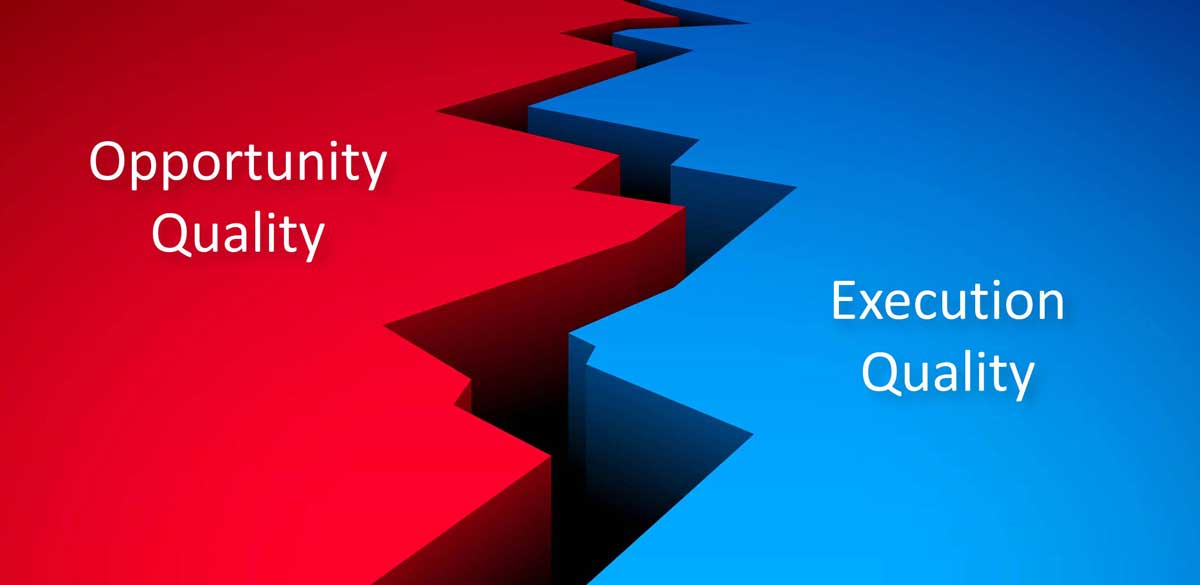
Even if your Stage-Gate® reviews are highly evolved, I’ll bet they’re missing a critical element: I doubt they separate your projects’ Execution Quality and Opportunity Quality. In this issue, we’ll see why this is holding you back. We’ll also look at a brand-new release of Blueprinter® software that remedies this. Imagine you’ve got two project ... Read More
The “old way” of interviewing was to “validate” your idea with customers… but this leads to confirmation bias. With the “new way,” you focus on their needs and gain 5 benefits… 1) add new outcomes to your design, 2) eliminate costs for unimportant outcomes, 3) learn why they want outcomes (for better pricing), 4) engage them more, and 5) move faster. ... Read More
Quality guru Edwards Deming taught us that “94% of problems in business are systems driven and only 6% are people driven.” With the right systems, a company will grow and thrive. And few are more important than the “feedback loop.” Unfortunately, this term has been used so broadly that the original and powerful meaning has ... Read More
What is idea generation? Idea generation is the process of generating and selecting ideas to solve discrete problems. However, within the context of new product development, the goal of idea generation is to solve customer problems. After all, every new product begins as an idea. Therefore, if there’s an innovation job that we’d better do ... Read More
The average company only has a 25% success rate after it finishes its front-end work. With Six Sigma success, you’ve got three defects per million attempts… while your new product development is stuck at three defects per four attempts. Can you think of any other area in your company with this level of waste? Don’t let your competitors tame this frontier first.
More in white paper, www.catchtheinnovationwave.com (page 3)
Lean Startup is a powerful methodology, but B2B suppliers need to make some adjustments to avoid serious pitfalls. Instead of using a Build-Measure-Learn cycle, B2B producers should use a Learn-Build-Measure-Learn cycle. In other words, they should begin with B2B-optimized customer interviews. ... Read More